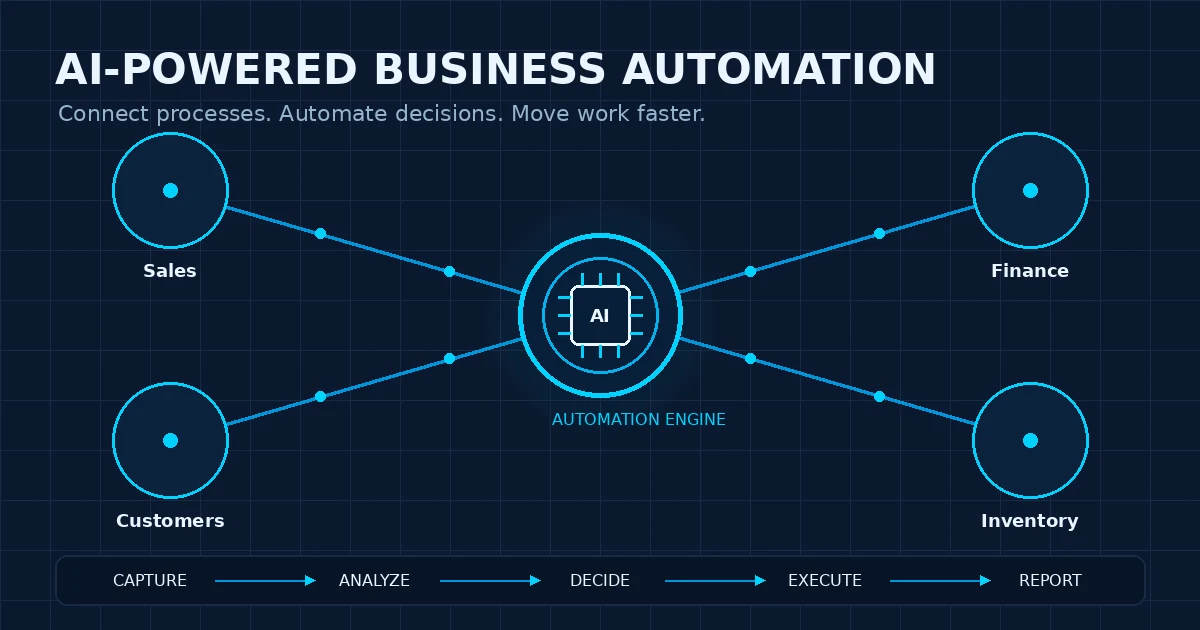

Learning how to automate business processes with AI is the single fastest way to eliminate operational bottlenecks, reduce manual overhead, and scale modern enterprise workflows. Many business leaders recognize the potential of artificial intelligence, yet struggle to connect machine learning models to daily infrastructure. Understanding how to automate business processes with AI starts with identifying high-friction tasks—such as manual data entry, customer ticket routing, and invoice reconciliation—and replacing fragmented steps with intelligent API automation.
When evaluating how to automate business processes with AI, companies must distinguish between generic conversational chatbots and true workflow automation engines. Modern digital systems combine standard software logic with specialized AI models to process unstructured documents, validate compliance, and trigger instant database updates without human intervention.
Quick Summary for Decision Makers:
- Focus on Unstructured Data: Discover how to automate business processes with AI by deploying parsing models to read PDF invoices, unstructured emails, and receipts.
- Preserve Deterministic Logic: Keep fixed business rules in custom software code while applying artificial intelligence only for natural language parsing and decision routing.
- Integrate Native Payment Rails: Connect automated pipelines to local payment networks like Safaricom Daraja M-Pesa API to reconcile transactions instantly.
- Maintain Human Oversight: Implement human-in-the-loop validation for financial thresholds while letting automated pipelines handle preparation.
Table of Contents
4 Essential Levels of Enterprise Process Automation
To master how to automate business processes with AI, organizations must structure their digital initiatives across four core operational levels:
- Level 1: Rule-Based Task Automation: Standard software scripts process structured data, moving static files between systems following fixed binary logic.
- Level 2: Intelligent Document Parsing: Natural Language Processing (NLP) models read incoming unstructured files, extracting key-value pairs from supplier invoices and purchase orders.
- Level 3: Dynamic Decision Routing: Machine learning classifiers analyze incoming customer intent, scoring lead urgency or routing technical support tickets directly to specialized teams.
- Level 4: Autonomous Agentic Workflows: Multi-step AI agents execute end-to-end task chains, retrieving CRM data, drafting technical proposals, and updating internal operational ledgers automatically.
Knowing how to automate business processes with AI across these four levels ensures that companies do not over-engineer simple tasks or under-automate complex operational bottlenecks.
High-Impact Operations to Automate First
When implementing an enterprise strategy to automate business processes with AI, prioritize operational areas where human manual data entry introduces severe delays or processing errors.

1. Automated Invoice and Expense Reconciliation
Manual bookkeeping requires finance teams to cross-reference physical receipts, bank statements, and vendor invoices line by line. Implementing intelligent parsing tools allows your enterprise platform to extract vendor line items automatically, verify numbers against database ledger entries, and flag discrepancies for audit. Explore our specialized custom enterprise software development solutions to build scalable backend integration pipelines for your business.
2. Intelligent Customer Support Triage
Static auto-responders fail to resolve complex customer issues. Advanced AI agents analyze incoming support emails, compare context against internal documentation databases, answer routine queries instantly, and route technical escalations to designated staff members.
3. Automated Lead Enrichment and CRM Pipelines
Sales personnel spend valuable hours manually researching new leads. Learning how to automate business processes with AI in sales enables automated workflows that capture incoming form submissions, query public metadata, summarize company profiles, and update CRM records automatically.
4. Supply Chain and Inventory Tracking
Integrating predictive models with warehouse databases helps management forecast inventory shortages, analyze vendor fulfillment speeds, and automate restock order generation before stockouts occur.
Strategy Matrix: Rule-Based vs Off-the-Shelf vs Custom AI
Selecting the correct technical architecture is critical when planning how to automate business processes with AI for long-term scalability.
| Performance Metric | Standard Rule-Based Scripts | Off-the-Shelf SaaS Tools | Custom AI & API Pipelines |
|---|---|---|---|
| Best Operational Fit | Fixed, linear tasks | Generic text generation | End-to-end enterprise workflows |
| Unstructured Data Handling | Zero capability | Basic text summarization | Deep context & document extraction |
| Local API Integration | Webhook dependent | Limited to global rails (Stripe) | Direct integration (M-Pesa, Local Banks) |
| Recurring Cost Model | Low initial build cost | High per-seat monthly subscription | Zero recurring per-user SaaS tax |
| Data Privacy & Control | High internal control | Vendor hosted (Data exposure) | Full private cloud ownership |
5-Step Implementation Roadmap for Enterprise Operations
Executing a successful rollout requires a disciplined, step-by-step strategy:
- Audit Operational Bottlenecks: Map internal workflows for one week to evaluate how to automate business processes with AI where manual hours are highest.
- Consolidate and Clean Data Architectures: Machine learning efficiency relies on underlying database structure. Clean legacy spreadsheets into normalized relational database schemas.
- Build a 4-Week Functional Pilot: Implement an initial pilot focused on one operational friction point, such as automated invoice parsing or lead enrichment.
- Connect Native API Endpoints: Integrate automated workflows directly with internal core platforms, local payment gateways, and custom reporting dashboards.
- Establish Performance Metrics and Scale: Monitor task cycle times and output accuracy. Once accuracy exceeds 98%, reduce manual spot-checks and extend automation across adjacent departments.
Avoiding Common Automation Pitfalls
Businesses exploring how to automate business processes with AI often fall into predictable implementation traps:
- Automating Broken Workflows: Automating an inefficient, poorly defined manual process only yields automated chaos. Map and streamline manual rules before writing code.
- Ignoring Local Infrastructure: Global SaaS tools frequently lack native webhooks for regional systems. Ensure your solution natively supports local payment processors and customized database architectures.
- Neglecting Security and Governance: Unchecked AI agents can leak internal enterprise data if proper role-based access control (RBAC) and database encryption are missing.
Understanding how to automate business processes with AI equips enterprises to scale operations smoothly, eliminate repetitive manual labor, and maintain a competitive edge in modern digital markets. By pairing intelligent machine learning models with robust software infrastructure, your business can build high-performance systems engineered for growth.